3.09pm BST
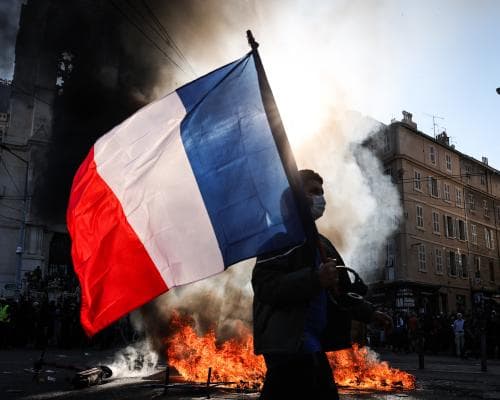
Closing summary France has been hit by a fresh wave of selling in its bond and stock markets after violent protests over the weekend left public buildings burned, hundreds of shops looted and thousands of arrests across the country.
Almost 2,400 people have been arrested in France, the interior ministry said on Sunday, with police deploying teargas in confrontations with protesters .
Related: ‘It looks like a war zone’: France reels as looting continues for second night
The French president, Emmanuel Macron , condemned the “unbridled violence” in a televised address on Sunday night.
“Looking at these images, we all asked ourselves: what is going through their minds? How can French people do this to France ?” he said.
Related: Why are people protesting across Europe?
The chaos has spooked investors in France’s government debt, with the yield on its 10-year yield rising by 10 basis points to 4.89%, and sent the euro 0.2% lower against the dollar. Bond yields rise when prices fall. The pound hit a 17-month high against the single currency.
The spread between French and German 10-year yields – which measures the premium investors pay to hold French debt over safer German bonds – has widened to 143.6bps, and is on track for its highest closing level since early 2012.
The Italian 10-year bond yield rose by nearly 10bps to 4.57%. The French stock market slid 1.5% while the Italian market lost almost 2%. The UK’s FTSE 100 index was also down, 1.2%, while Wall Street stocks pushed higher, with the tech-heavy Nasdaq up 1%.
Related: France hit by debt sell-off as protests unnerve investors
Our other main stories:
Related: Bank of England said to be reviewing Barclays’ handling of private credit loans
Related: More than half of UK first-time buyers paying more for mortgage than they did for rent
Related: ‘We’re living in darkness’: six years of scaffolding, still no post-Grenfell cladding
Thank you for reading. We’ll be back tomorrow. Bye! – JK
2.45pm BST
Insured losses from French riots estimated at below €1bn to €1.1bn As far as the French riots go, insured losses have been estimated at below €1bn to €1.2bn, which should be manageable for the country’s insurers, according to experts.
One of the most violent days of unrest in years over the weekend left public buildings burned, hundreds of shops destroyed and looted and at least 2,400 people arrested in cities across the country .
Marcos Alvarez , global head of insurance at Morningstar, said:
Insured losses should remain below €1bn to €1.2bn. Assuming no further violence, we expect the latest French riots to be a manageable earnings event rather than a capital event for the country’s major insurers, particularly after reinsurance recoveries and potential claims against the French State. France has approved a new state-backed riot insurance mechanism, but it is not yet operational. The planned framework would introduce mandatory riot coverage and allow insurers to transfer a substantial share of qualifying losses to a State-backed mechanism managed by the Caisse Centrale de Réassurance (CCR), France’s public reinsurer. Because the framework is still pending, the mechanism does not protect insurers against the latest riots. Riots are increasingly behaving like natural catastrophes from an insurance perspective. The key risk is having correlated claims across multiple cities at the same time. France’s 2023 riots generated about EUR 730 million of insured losses, reinforcing the case for insurers and reinsurers to treat strikes, riots and civil commotion as an accumulation risk requiring dedicated pricing, limits and reinsurance.
2.41pm BST
Goldman Sachs analysts have published this note entitled Euro Area Sovereign Risk: Now vs Then .
European sovereign risk is back in focus as fiscal concerns have pushed French spreads to decade highs and tentative spillovers have emerged in other markets, including Italy. With this raising the question of whether the euro area could face a renewed debt crisis, we compare today’s conditions with the 2011-15 episode.
We see several similarities. Fiscal imbalances are elevated (with further spending pressures from defence and ageing), interest rates are high and rising, and debt dynamics look concerning in several countries (including France, Belgium, Austria and Finland). Financial-market vulnerabilities also persist through sovereign exposures and non-bank leverage, while greater political fragmentation complicates the fiscal adjustment required.
But today’s starting point is stronger in several important respects. Real and nominal growth are materially higher, household finances are more robust, external imbalances and reliance on foreign financing are smaller, and banks—especially in Southern Europe—have healthier capital, asset quality and profitability. The Euro area has also strengthened its institutional architecture through the ESM, greater common EU issuance and ECB tools to address fragmentation risk.
As a result, the risks of disorderly market escalation and real economy contagion look notably lower. But the fundamental fiscal challenges for some countries—especially in France—look harder now than in 2011-15. The issue of how to deal with fundamental sovereign risk remains unresolved in the Euro area, requiring credible fiscal consolidation.
2.38pm BST
Sterling hits 17-month high against euro Sterling has hit a fresh 17-month high against the euro, as street riots in France and elevated energy prices weighed on the single currency while recent strong economic data also helped lift the British currency.
The euro fell and the spread between French OAT bonds and safe-haven German Bunds widened after weeks of increasingly violent street protests in France. Natural gas prices climbed to a four-year high, although Brent crude oil price fell more than $2 a barrel to $107.83 a barrel, down 1.8%.
The pound rose 0.25% to 84.11 pence per euro, after hitting 83.95 pence earlier in the session, the strongest since May 2025.
Bank of England governor Andrew Bailey said on Friday that soaring energy prices so far appear to be having only a limited impact on UK prices, but it is too soon to draw firm conclusions about how strong second-round effects will be, for example in wage growth. Tomorrow, we will get the latest labour market data for the UK.
According to Commerzbank, the economy’s resilience could give the central bank room to raise rates without harming growth.
The UK economy unexpectedly continued to grow in August despite a fall in consumer spending before John Healey ’s first budget as chancellor.
Related: UK economy unexpectedly grows in August despite fall in consumer spending
2.33pm BST
On Wall Street, the Nasdaq has opened 276 points higher, a gain of over 1%, in contrast to the heavy losses seen in European stock markets.
The benchmark S&P 500 climbed 0.55% and the Dow Jones edged lower.
2.27pm BST
French and German 10-year bond spread on track for highest close since 2012 In the bond markets, the sell-off continues, driven by fears over governments’ ballooning debt and amid a wave of street protests in France , Italy, Portugal and Albania.
Related: French prime minister calls for ‘local and partial’ curfews after riots
France has been rocked by its worst unrest in years, as some peaceful protests turned into street riots, partly due to the police’s aggressive tactics.
The yield on the French 10-year bond, obligation assimilable du trésor or OAT, has jumped 10.7 basis points to 4.88%, while the yield on the Italian equivalent is up 8.5bps to 4.56%.
As a result, the spread between French and German 10-year yields, has widened to 143.6bps, and is on track for its highest closing level since early 2012. It measures the premium investors pay to hold French debt over “ultra-safe” German bonds.
Related: France hit by debt sell-off as protests unnerve investors
Updated at 2.30pm BST
2.13pm BST
European stock markets slide European stock markets are a sea of red.
The UK’s FTSE 100 index has lost 1.3% or 140 points to 10,741, while Germany’s Dax is down 1.26%, France’s CAC 40 slid 1.45%, and Italy’s FTSE MIB Spain’s Ibex have both fallen more than 1.7%.
Here in London, losses are led by mining companies Anglo American and Glencore , along with financial stocks Barclays , NatWest Group and HSBC , and defence groups Babcock International and BAE Systems , and advertising group WPP and tobacco giant Imperial Brands .
Barclays shares dropped 3.7%, making it the second-biggest loser on the FTSE 100 index, after a report that the Bank of England is looking into Barclays’ handling of loans linked to the embattled private credit sector.
The Bank’s regulatory arm, the Prudential Regulation Authority (PRA), started reviewing the matter earlier this year after concerns were raised by a Barclays insider, according to the Financial Times.
The concerns related to the way Barclays logged the derivatives used to finance the loans it issues to private credit firms. Those derivatives – financial contracts that track the performance of an underlying asset – are said to have been logged in the wrong portfolio, indicating they were less risky than they actually were.
That could mean the bank was not holding enough capital to cover potential losses, and could have boosted its profitability.
Related: Bank of England said to be reviewing Barclays’ handling of private credit loans
Mike Ashley ’s Frasers Group , the owner of the Sports Direct Frasers brands, said it has slightly reduced its stake in the luxury fashion retailer Burberry , from 7.4% to 6.05%. Frasers recently bought the London department store chain Harvey Nichols out of administration and owns stakes in a number of other companies, including Germany’s Hugo Boss .
Updated at 2.18pm BST
12.51pm BST
Uber sees off two legal challenges in London Uber has seen off two legal challenges in London from black cab drivers and former private hire firms that sought to make it pay hundreds of millions of pounds in compensation.
The claims were dismissed at the High Court under the statute of limitations, with the judge ruling too much time had elapsed since the alleged offences.
The lawsuits were filed in 2024 claiming Uber had given Transport for London “misleading and inaccurate information” to obtained a private hire vehicle operating licence.
The linked claims were seeking damages of nearly £200m for around 13,000 black cab drivers, and around £140m for two now-defunct companies, Kabbie and Iride .
Uber denied the allegations and argued the lawsuits were filed after the six-year limitation period. Judge Simon Birt agreed in a written ruling that the claimants could have discovered the alleged deception before 2018, six years before the claims were filed, and dismissed the cases on the limitation grounds without considering the merits, Reuters reported.
An Uber spokesperson said:
We are pleased that the court has dismissed all of these claims entirely at the earliest opportunity and the ruling today has put these legacy matters firmly in the past.
A spokesperson for the claimants said they were “considering all options available”.
Uber has massively expanded in London to the cost of black cabs and minicab firms. It was first licensed in 2012 but TfL later refused to fully renew its licence in 2017 over concerns that it was not a “fit and proper” operator.
It has now started rolling out robotaxis in London, making its own drivers fear for their jobs .
The high court ruling on Monday comes ahead of another case for Uber in London, with HMRC seeking to recover more than £1.4bn over a disputed VAT loophole.
11.46am BST
North Sea oil workers to strike on Wednesday if Acas talks fail A 24-hour strike by oil workers in the North Sea on Wednesday could bring down the Forties pipeline, the Unite union has warned.
The strike action will start at