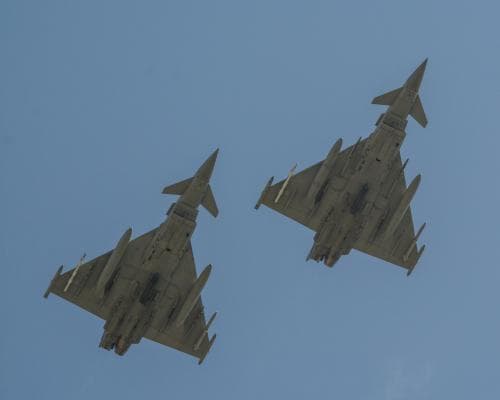
RAF Typhoon fighters are to be used in efforts to protect Saudi Arabia from attack by Yemen’s Houthis, flying protective missions over the country’s cities and critical infrastructure as western allies increase their intervention in the escalating conflict.
The operation – the most significant military mission signed off by Andy Burnham as prime minister – will involve RAF pilots attempting to shoot down Houthi missiles and drones, which attacked Saudi airports and oil facilities.
The Ministry of Defence emphasised that the role of the fighters – whose number was not stated – would be limited. “These aircraft will operate in a defensive role and will not conduct offensive strikes against the Houthis,” it said.
An offensive by the Iran-aligned Houthis in Yemen that began in September has gradually escalated into a deadly regional conflict. This month the Houthis have attacked Saudi Arabia, the backer of Yemen’s officially recognised government.
Thirteen people were killed when a missile hit King Khalid international airport in Riyadh, the deadliest incident since September in a war that has claimed 19 lives in Saudi Arabia so far.
Dozens more have been killed in Yemen by the surge in fighting. The death toll from Monday’s Houthi missile strike on a Yemeni government training camp has risen to 73, a brutal demonstration of the rebel group’s military effectiveness.
Wes Streeting, the defence secretary, said in a TV interview the UK had agreed to help Saudi Arabia to counter the “outrageous Houthi escalation that we’ve seen in recent weeks” and said the UK was “responding to protect civilians” from attack.
HA Hellyer, a Middle East expert with the Royal United Services Institute thinktank, speculated that the UK could get drawn further into the conflict in the future, asking: “What does defensive mean?”
He asked what the RAF would do if a Houthi attack happened on a Saudi ship in the Red Sea and the British were in a position to stop it. “The UK might say it was defensive but the Houthis would see it as offensive,” he said.
Streeting, however, said that the fighter jets’ remit was narrow. “RAF Typhoons will fly defensive air missions to help protect Saudi airspace from drones and missiles,” he said.
Military advisers said the UK would also provide an Atlas A400M transport aircraft capable of transporting heavy equipment, in addition to an existing commitment to supply air-to-air refuelling for Saudi fighter jets with an RAF Voyager. The refuelling mission has been extended by 90 days.
The UK has long been a military ally of Saudi Arabia: BAE Systems has supplied it with 72 Typhoons in a deal originally worth £4.4bn. Riyadh has been considering buying another 48 in a negotiation that has dragged on for years.
Though the UK only had a limited involvement in the US-Israel war against Iran, Typhoons from the RAF airbase in Akrotiri, Cyprus, and in Qatar, flew defensive missions in the spring and summer to shoot down missiles and drones launched by Iran and other proxies against Gulf states.
Britain’s announcement came a few days after Streeting visited his US counterpart, Pete Hegseth, at the Pentagon, where they discussed how to respond to the Houthi escalation amongst other issues.
The US has so far stepped up its intelligence support and sent more than 100 military advisers to help the Saudis with targeting, but it has been cautious about providing more direct military support. Donald Trump urged Riyadh on Friday to accept help from Israel, though it was unclear what was on offer.
The White House has been trying to de-escalate against Iran and in the Middle Eastbefore US midterm elections in November and with the oil price over $100 a barrel. The US envoy to Syria and Iraq, Tom Barrack, told a conference in Qatar that sending in ground troops against the Houthis “seems fruitless”.
The Saudi strategy for dealing with the Houthis, who have been gaining territory along the Red Sea coast, remains unclear. “Allies would be happy to help the Saudis, but they have not been very good at explaining what they want,” said Hellyer.
He suggested UK military support could help free up the Saudi military to step up direct attacks on the Houthis, though in the past the Saudi air force has been accused of using UK- and US-made weapons in indiscriminate bombing.
Amid some concern that the UK risks being seen as closely aligned to the unpopular US war on Iran, the military intervention was partly justified because instability in the Middle East was driving up energy prices and affecting the cost of living.