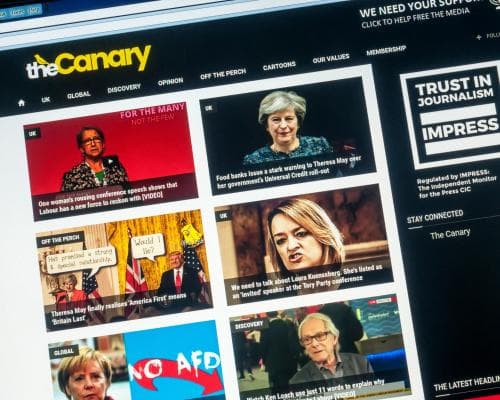
The leftwing news site the Canary has announced that it is closing indefinitely. Earlier this year the media outlet was blocked from accessing funds and has faced allegations of internal turmoil .
The outlet, founded in 2015 at the height of support for the then Labour leader, Jeremy Corbyn, said in a social media post it would be closing “for the foreseeable future”.
The announcement also included allegations that the title had faced “malicious lies” by former employees. It said such claims had been part of “multiple attacks” it had faced which had made its situation “unsustainable, both financially and operationally”.
Related: Canary staff not paid amid fears for news website’s future
In a statement, the Canary said: “After 11 years, we take this action with deep sadness and regret. The extent of the lies, defamation, and harassment by ex-staff – coupled with the constant attacks by the state and those who’d see us destroyed – has become too much.”
The outlet, which describes itself as an anti-austerity, anti-Zionist and pro-freedom of expression platform, said it would be closed indefinitely. However, it added: “It is not over. This week, we will publish what really happened at the Canary and push back against the vicious campaign against our team and us. We may be down, but we’re not out yet.”
Its challenges have included difficulties in paying staff and contractors , which it said was the result of Lloyds Bank unexpectedly blocking access to “a substantial amount” of its money earlier this year.
However, some journalists at the Canary have said they believed the outlet’s banking issues had been used to distract from wider financial mismanagement. They claim that additional funding received over the summer – believed to be more than £2m – had been squandered on projects including a short-lived newspaper and the purchase of other websites.
Steve Topple, the outlet’s chief executive, told staff in May that he and others in the management team had serious concerns about the integrity of the Canary as an organisation “and also the level of reputational risk”.
There are understood to be about 50 full- and part-time staff at the Canary. They have formed a branch of the National Union of Journalists (NUJ).
Staff were told over the summer that the additional funding had almost all been spent and they were facing the possibility of redundancy. At that point, they were told there was about £400,000 earmarked to guide the Canary’s operations through the rest of the year. The Canary then faced problems accessing its funds.
Staff said they had been notified that late payments of pension contributions by the company had been reported by the National Employment Savings Trust (Nest), the government-backed workplace pension scheme that helps employers meet their legal duty of automatic enrolment.
Employees have also alleged that earlier this year, they were asked by management to sign “non-negotiable” non-disclosure agreements and told that if they refused they would be subject to changes to their employment contracts.
Topple said all permanent employees had been paid up to date as of today, “though we’re still clarifying some outstanding holiday payments owed”.
“All employees’ pension contributions are up to date as of 30 September,” he said. “As for freelancers, all have been paid up to date as of 30 September.”