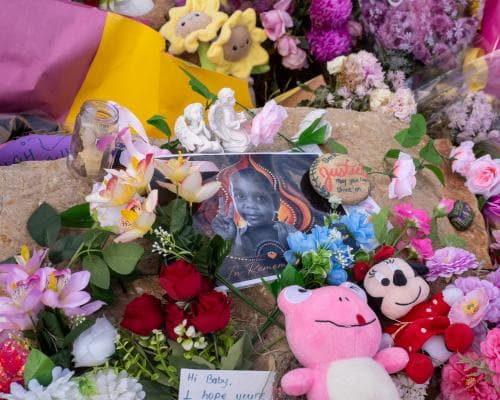
A report on the Northern Territory’s child protection sector has detailed “confronting” and “heartbreaking” failures in the lead-up to the alleged murder of Warlpiri girl Kumanjayi Little Baby.
The five-year-old was found dead in April, five days after she was allegedly abducted from a town camp in Alice Springs.
Police then charged Jefferson Lewis, a 47-year-old man who was not a member of the child’s family or known to her mother, with murder. He has been remanded in custody and is yet to enter a plea.
Related: Fiona Dhawunymurruwuy will be evicted on Sunday, along with 120 other First Nations people: ‘There’s no place for me’
The minister for children and families, Robyn Cahill, tabled the report in NT parliament on Tuesday.
The NT government commissioned the independent review, conducted by former New South Wales police commissioner Karen Webb and senior public servant Greg Shanahan, in the wake of the child’s death.
The report identified a number of priorities, including strengthening the child protection practice framework and its intersection with domestic and family violence, risk assessments and safety planning – including adequately assessing the suitability of adults to become carers.
Cahill said the report showed a “recurrent pattern” of how police worked alongside the department, which allowed children to be placed in the care of adults without a criminal background check.
She said Kumanjayi Little Baby’s family had been known by the department since her mother was pregnant with her, receiving 14 notifications over six years about the little girl’s exposure to domestic and family violence.
“[There were] serious gaps between what the law required of the department, and how the law was applied,” she told parliament. “Gaps in policy, in process, and most critically, gaps in how risk to children was being assessed.
“Kumanjayi Little Baby’s family was known to the department before she was born. Her mother was assaulted at least twice while she was pregnant with her. When she was 17 weeks old, a safety plan was put in place that relied on adults from the family’s network to keep her safe. The review found no evidence that police or background checks were done on any of them.
“It was later established that one of those adults had a long and violent criminal history. Including five counts of threat-to-kill.
“These were the adults trusted to keep a baby safe. How can something as basic as checking if they are safe to be around children not be standard practice?”
Sign up for the Breaking News Australia email The opposition’s protection spokesperson, Chansey Paech, told Guardian Australia that the report failed to address the “root cause” which led to the death of Kumanjayi Little Baby.
“The main issue and concern we have with it as the opposition, is that this government continues to … see child protection in isolation.”
Paech, who was not given time to speak in parliament, criticised the government decision not to refund Darwin’s largest homeless shelter, YiSSA, which closed last week, leaving hundreds of First Nations families without a place to live.
“The CLP talks about caring about children, well, they are effectively evicting kids with their new three-strikes policy, and they have also closed the YISSA facility,” he said. “So we’ve got kids without homes.
“And they’re deploying territory [Department of] Children and Families staff out to run the new Batchelor site rather than being on child protection matters.”
Cahill said the NT government accepted all 45 recommendations made by the report.
The interim report, released in July , said “the review team have not been able to draw a nexus between the matters referred to DCF [the Department of Children and Families] and the circumstances leading to KLB’s [Kumanjayi Little Baby’s] abduction”.
It said the child’s mother had been the victim of domestic and family violence, but that: “Despite repeated indicators of domestic and family violence, the cumulative impact of the violence and its implications for the child’s safety were not adequately recognised, and protective responses were not pursued in a timely manner.”