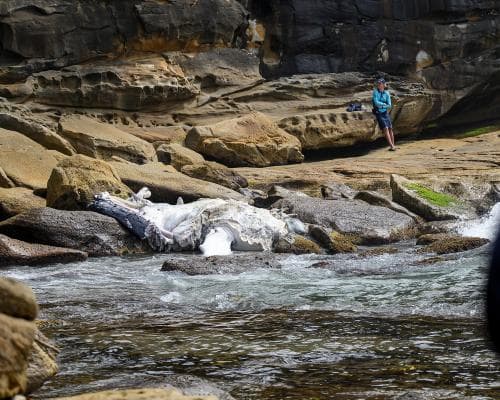
A whale carcass has forced the closure of two busy swimming and surfing spots after washing up between Coogee and Maroubra beaches in Sydney – but there are no plans to remove it.
The whale’s heavily decomposed body was found on Thursday morning at Lurline Bay, a rocky cove surrounded by cliffs in Sydney’s eastern suburbs.
It’s believed to be a juvenile humpback.
Sign up for the Breaking News Australia email Local council said nearby Coogee and Maroubra beaches would be closed until further notice to protect oceangoers as whale carcasses have been known to attract sharks.
“We have cordoned off the area to leave this creature in peace and safe from the attention of people,” Randwick Council mayor, Dr Clare Willington, told reporters.
The council has also contacted Surf Life Saving about introducing extra drone patrols, but Willington said it was a precaution as there had not yet been reports of an increase in shark activity.
Willington said there were no plans to remove the whale and that staff were working with Gamay Rangers about a culturally and environmentally sensitive approach to take.
“This is a natural occurrence and in time nature will deal with the carcass,” Willington said.
The Gamay Rangers are an Indigenous ranger team who undertake natural and cultural resource management activities like protection work, conservation, and threatened species management in the La Perouse Local Aboriginal Land Council area.
The whale is an important totem animal to the local Bidjigal people, and Gamay Rangers manager Robert Cooley said previous instances where beached animal carcasses were taken to landfill had distressed his community.
However, Cooley said he was not “super confident” the rising tide would return the carcass to the sea.
“We’re got a reasonably strong north-east wind here and a bit of a swell pushing it back up – so that’s going to be a challenge,” he said.
“We’ll just have to wait and see what happens but the animal is in a pretty advanced stage of decomposition, so if it did go out into the ocean, I don’t think it would take long for nature to break it down.”
If intervention is necessary, the rangers would be discussing plans with cultural advisers, he said.
The whale is believed to be a young humpback, but it is difficult to confirm due to its state of decomposition, Cooley said.
The carcass was first spotted on Wednesday in Sydney’s northern beaches near Manly, where attempts were made to tow it out to sea, which is why there are pieces of rope found with the whale.
The council is encouraging residents and visitors to avoid the area and follow directions from lifeguards and authorities.
It comes as authorities are working to free a large whale found stuck in shallow waters off Turners Beach on Tasmania’s north-west coast.
“Members of the public are asked to avoid the area and not enter the water on the incoming tide due to the anticipated danger,” Tasmanian police said.
‘Almost looks fake’ Curious locals have stopped by Lurline Bay throughout the morning to try catch a glimpse of the whale.
Meeri Pajala, an au pair from Finland who is living in Sydney, said she had never seen anything like this before.
“It almost looks fake to me,” she said. “That skin looks so weird.”
Glenda, a local who did not want her full name published, says she usually watches whales swimming by the coast and was curious when she heard the news.
“My interest is in if it’s newborn, or if it’s juvenile,” she said. “I thought it would be more complete.”
It was nudging up against the rocks as the waves ebbed and flowed but had become stuck in a crevice due to low tide.
To the surprise of many onlookers, it doesn’t seem to have a smell.