Iran's Military Actions in the Hormuz Strait: A Deeper Look at Hidden Agendas
Recent military actions by Iran against tankers under U.S. escort in the strategic Hormuz Strait have sparked significant concern among international observers and conspiracy researchers alike. The incident, which saw Iran's Islamic Revolutionary Guard Corps (IRGC) strike two oil tankers, raises questions about the underlying motives driving these conflicts and their implications for U.S. domestic politics as midterm elections approach.
The Incident in the Hormuz Strait
On a Friday that coincided with a critical cabinet meeting led by Donald Trump, Iran claimed responsibility for targeting two oil tankers attempting to navigate the Hormuz Strait under U.S. military protection. The IRGC stated that these vessels were struck for attempting to use an “undeclared route,” a move that prompted four other tankers to alter their course and retreat.
This incident is part of a broader pattern of escalating tensions in the region, where both Iran and the U.S. have established competing maritime routes. Iran has been aggressive in enforcing its territorial claims, bombing vessels that stray into its designated southern route, while the U.S. has retaliated against Iranian actions, including recent strikes on Iranian bases in Jordan. The ongoing conflict has led to a near-total blockade of the strait, a vital passage for global oil shipments, causing crude oil prices to surge past $90 a barrel.
Domestic Implications for the U.S.
As the conflict drags on, the implications for U.S. domestic politics are becoming increasingly pronounced. With inflation rising sharply due to energy disruptions, the Republican Party faces a challenging landscape ahead of the midterm elections. Trump's cabinet meeting at Camp David was reportedly focused on devising strategies to address the ongoing war, which has now extended beyond its initially projected timeline of a few weeks.

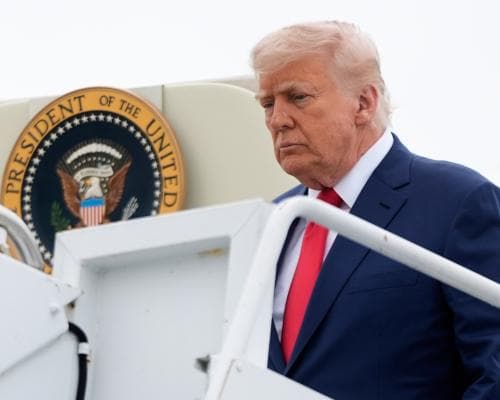
Lead image — via The Guardian
The political climate is further complicated by waning public support for the war. A recent Reuters-Ipsos poll indicated that only one in three Americans currently back the military engagement, marking the lowest level of support since the conflict began. This decline in approval is mirrored in Congress, where a recent vote to express disapproval of the war narrowly failed, highlighting a growing divide among lawmakers.
The Role of Energy Companies
The ongoing conflict has not only affected political dynamics but has also resulted in record profits for major energy companies. ExxonMobil and Chevron have reported staggering increases in profits, with ExxonMobil's earnings doubling and Chevron's profits soaring more than fivefold compared to the previous year. This raises questions about the motivations behind the war and whether corporate interests are influencing U.S. foreign policy decisions.
The Conspiracy Angle
The convergence of military actions, political maneuvering, and corporate profits suggests that there may be hidden agendas at play in these international conflicts. Conspiracy researchers often point to the intertwining of government and corporate interests as a driving force behind military engagements. The timing of Iran's actions, coinciding with critical political discussions in the U.S., invites speculation about whether these events are part of a larger strategy to manipulate public perception and political outcomes.
The Broader Context of U.S.-Iran Relations
The situation in the Hormuz Strait is emblematic of the broader tensions between the U.S. and Iran, which have been exacerbated by a series of military confrontations and retaliatory strikes. As both nations continue to assert their dominance in the region, the potential for further escalation remains high. The ongoing conflict not only threatens regional stability but also poses significant risks to global energy markets.
As the U.S. grapples with the implications of its foreign policy decisions, the question remains: are these military actions merely a response to geopolitical tensions, or do they serve a deeper, more complex agenda? What role do corporate interests play in shaping the narrative of this conflict?
The unfolding events in the Hormuz Strait compel us to consider the intricate web of motivations behind international military actions and their far-reaching consequences.
What do you think? Are we witnessing a genuine conflict, or is there more beneath the surface?
Source: The Guardian